

Top Custom AI Development Providers for Growth-Stage Physical-Technology Companies
- Physical-technology companies need AI partners who can handle sensor data, edge hardware, and safety constraints, which most software-only shops have never touched.
- Five provider types cover the market: embedded and edge specialists, industrial AI integrators, boutique custom AI studios, cloud and platform partners, and fractional AI engineering teams.
- MIT's 2025 research, as reported by Fortune, found partner-led AI projects succeed about 67% of the time, roughly twice the rate of internal builds.
- Ask domain questions before you ask for a price: where inference runs, how the model behaves when a sensor fails, and who owns the weights.
- Run a paid two-to-four week pilot against your own data, and score every finalist on the same sheet.
If you run a growth-stage hardware or physical-technology company and you are shopping for a custom AI development partner, the short answer is that you should pick a provider type first and a company second. The right type depends on where your models have to run, how much of your data lives in machines instead of databases, and how much AI skill you plan to keep in-house. I have sat on both sides of this decision, and the pattern repeats: teams that choose the wrong type of partner burn the first six months finding that out.

Why Physical-Tech AI Needs Are Different
Physical-technology AI differs from software AI because the model has to live next to a machine, a sensor, or a production line, and the data it learns from is messy in ways a database never is. A pure-software shop can iterate against a clean API. You cannot. Your inputs are vibration traces, camera frames, telemetry that drops out, and operators who override whatever the system says.
That changes the work in three ways. First, latency and connectivity matter. A model that takes two seconds to answer from the cloud is useless if a line has to react in two hundred milliseconds, so inference often has to run on the device or at the edge. Second, failure has a physical cost. A wrong answer in a chatbot is embarrassing, while a wrong answer on a machine can scrap product or stop a line. Third, the data is scarce where it counts. You may have millions of normal readings and a handful of examples of the failure you care about.
The market context makes the partner choice more important, not less. McKinsey's 2025 State of AI survey found that 88% of respondents use AI regularly in at least one business function, yet nearly two-thirds have not begun scaling it across the enterprise. Adoption is wide and production value is thin. Deloitte's reporting on its Tech Value Survey puts a finer point on it: 74% of organizations invested in AI, while only 5% of generative AI pilots reached sustained production. For hardware companies, the gap between a demo and a deployment is wider still.
The AMD-commissioned study Generative AI Experiences Rapid Adoption, but with Mixed Outcomes reports that 42% of companies abandoned most of their AI initiatives before production in 2025. Treat that as a vendor-sponsored number, but the direction matches everything else I see. Most AI work does not die in the lab. It dies at the point where it has to meet real equipment and real operations.
The Shortlist: Provider Types and Who Each Fits
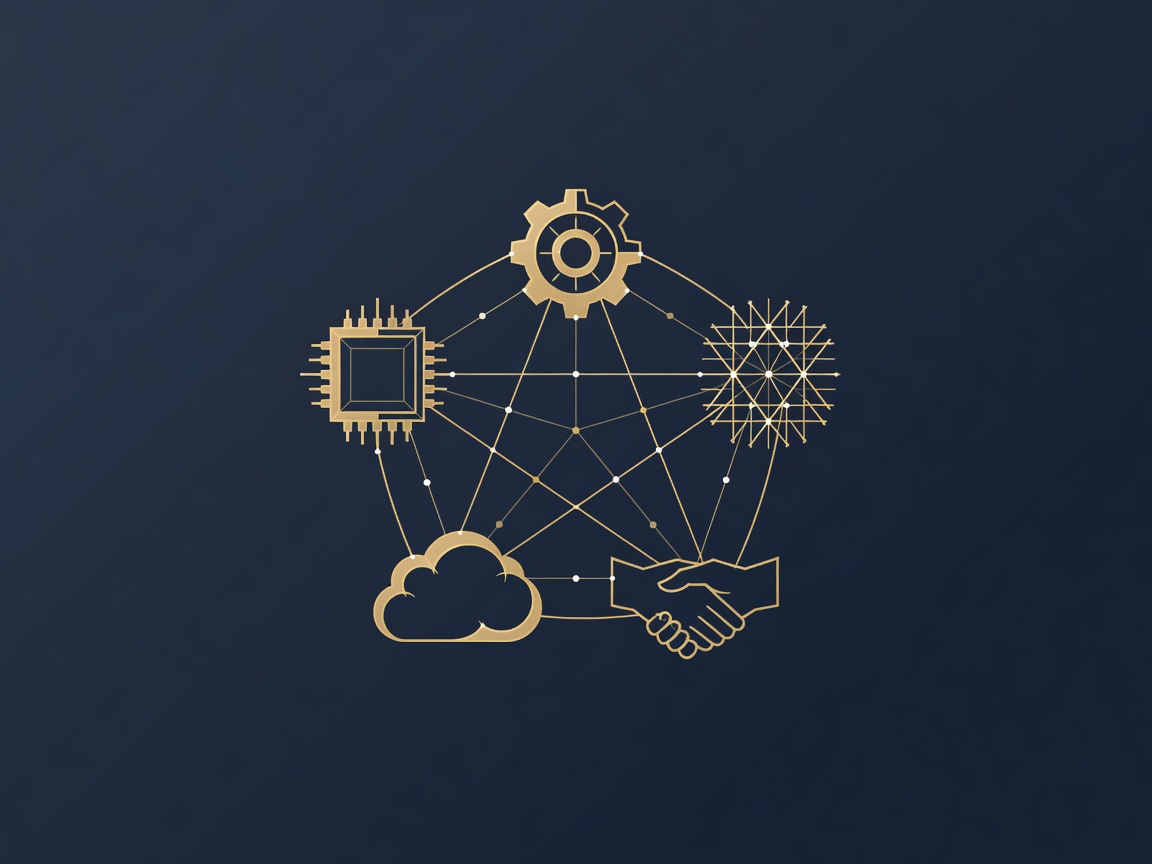
Five provider types are worth considering, and each fits a different kind of growth-stage company. I am naming types instead of ranking individual firms on purpose. Firms change quickly, and the type tells you more about fit than a logo does.
Embedded and edge AI specialists. These teams optimize and ship models onto constrained hardware. They fit you if your product is a device and the AI has to run on it, with tight power, memory, and latency limits.
Industrial AI integrators. These firms connect AI to plant systems, historians, controls, and enterprise software. They fit you if you operate equipment or lines and the hard part is wiring the model into existing operational technology.
Boutique custom AI studios. Small senior teams that build bespoke systems end to end. They fit you if your problem is unusual, your data is proprietary, and you want people who will think about your product instead of filling a template.
Cloud and platform partners. Implementation partners tied to a major cloud or AI platform. They fit you if your workload is mostly cloud-side analytics, you already run on that platform, and speed to a first version matters more than uniqueness.
Fractional AI engineering teams. Embedded engineers and a technical lead who work inside your team on a retainer. They fit you if you want to build internal capability and need senior help for a year, not a finished product handed over.
Most growth-stage physical-tech companies end up with a primary partner of one type and a smaller supporting relationship with another. A device maker, for example, might hire an edge specialist for the model and a platform partner for the fleet dashboard.

Rationale for Each Option
Each type earns its place for a specific reason, and each has a predictable weakness. Knowing both lets you choose on purpose instead of by whoever replies first.
Edge specialists win on performance and cost per device. They know quantization, pruning, and the quirks of specific chips. Their weakness is breadth. They may build you a superb on-device model and have little to say about the data pipeline or the business process around it.
Industrial integrators win on reality. They have been inside plants, they respect safety rules, and they know why the historian data is wrong on Tuesdays. Their weakness is pace and price. Large integrators can be slow, and their engagements can lean toward heavy process.
Boutique studios win on fit and senior attention. You talk to the people doing the work. The weakness is capacity and continuity. If two of five people leave, your project feels it, so ask how knowledge is documented and what the handover looks like.
Platform partners win on speed and support. Reference architectures and pre-built services get you to a working version quickly. The weakness is lock-in and sameness. What you build may be easy to copy and hard to move.
Fractional teams win on capability transfer. After a year you own the skills. The weakness is that you carry the management load. Someone on your side has to direct the work, and that someone is usually already overbooked.
The build-versus-buy evidence leans toward partnering, with caveats. The Fortune summary of MIT's GenAI Divide report says purchased and partner-led solutions succeed about 67% of the time, while internal builds succeed about one-third as often, and that 95% of enterprise pilots show no measurable financial return. Read those as directional. The sample skews toward enterprise software, not hardware. Still, the lesson holds for physical-tech teams with thin AI benches: do not build the commodity parts yourself. If you are weighing that decision, my earlier piece on choosing a custom AI development partner for a growth-stage company covers the build-or-partner question in more depth.
Domain Questions That Filter Out Software-Only Shops
The fastest way to separate physical-tech competence from software confidence is to ask questions a software-only shop cannot answer from a slide. Bring these to the first call, and listen for specifics instead of reassurance.
Where will inference run, and why? A credible partner reasons from your latency, power, connectivity, and cost constraints to a deployment choice. A weak one defaults to the cloud because that is what they know.
What happens when a sensor fails or drifts? Real systems degrade. Good partners describe fallback behavior, confidence thresholds, and how the system tells an operator it is unsure.
How will you handle rare failure data? You will not have many labeled failures. Strong answers mention synthetic data, anomaly approaches, transfer learning, or structured ways to capture new examples from the field.
How do updates reach deployed devices? Ask about over-the-air updates, rollback, versioning, and how a bad model gets pulled. This question exposes weak operations fast.
What safety and compliance constraints have you worked under? You are not looking for a certificate. You are looking for someone who has had a safety engineer push back on a design and knows how to respond.
Who owns the model, the weights, and the training data pipeline? Get the answer in writing. RNF Technologies frames the principle well: buy the commodity, build the difference. The difference is usually your data and the trained model on top of it, so you should own both.
Can you show a deployment that has run in production for a year? Demos are cheap. A year of uptime, with a maintenance story, is evidence. For a longer checklist of this kind, see the buyer's checklist for vetting an AI implementation partner.
Running the Evaluation
Run the evaluation as a short, structured contest instead of a series of conversations. Conversations reward the best talker. A pilot rewards the best builder.
Start with a written brief of one page: the problem, the data you can share, the environment the model must run in, and the result that would count as success. Send the same brief to three finalists, no more. Anything wider turns into a part-time job.
Score every finalist on the same sheet. A simple version weights five things: domain fit, technical approach, evidence from past deployments, commercial terms including ownership, and how the team communicates when something goes wrong. Give each a score from one to five, write down why, and compare after the calls instead of during them.
Then pay for a small pilot. Two to four weeks against a slice of your real data tells you more than any proposal. Define the pass criteria before you start, such as accuracy on a held-out set, latency on the target hardware, or the number of false alarms per shift. If a provider will not do a paid pilot with clear criteria, treat that as an answer.
Watch the commercial terms with the same attention. Pricing models differ by type, from fixed-scope projects to monthly retainers, and the cost that bites later is maintenance. If you want a grounded view of that, what an AI implementation actually costs in 2026 breaks down a realistic budget.
Last, plan the handoff from day one. Decide who on your team will own the system after launch, what documentation you require, and how retraining will happen. A partner who builds you something only they can run has not solved your problem. They have rented you a dependency.

Frequently Asked Questions
What Is Custom AI Development?
Custom AI development is the design, training, integration, and maintenance of AI systems built around a specific company's data, workflows, and hardware, instead of a generic off-the-shelf product. For physical-tech companies, it usually includes work on sensors, edge devices, and operational systems.
How Do You Choose an AI Development Company?
Choose the provider type that matches where your models must run and how much capability you want to keep, then compare finalists on domain fit, evidence from production deployments, ownership terms, and results from a short paid pilot. Ask the domain questions in this article before discussing price.
Who Are the Best Custom AI Development Providers for Hardware Companies?
There is no single best provider. Embedded and edge specialists suit device makers, industrial integrators suit operators of equipment, and boutique studios suit unusual problems with proprietary data. The best choice is the type whose strengths match your constraints.
What Should a Growth-Stage Physical-Tech Company Look for in an AI Partner?
Look for production deployments on real hardware, clear answers on edge inference and sensor failure, written ownership of models and data, and a credible plan for updates and handoff. Senior people who stay on the project matter more than a long client list.
How Is AI Development Different for Physical Products?
The model must run near the machine, the data is noisy and often scarce for failure cases, and errors carry a physical cost. That makes edge deployment, fallback behavior, and update management part of the core design instead of afterthoughts.