

What RevOps Actually Is, and Why Your Pipeline Keeps Leaking
- RevOps (revenue operations) is one accountable owner sitting over the entire marketing, sales, and customer success machinery, so the systems, data, and handoffs that produce revenue answer to a single person instead of three departments pointing at each other.
- It is no longer a fringe idea. Roughly 48% of companies now run a RevOps function, up from 33% in 2020, and Gartner expects 75% of the highest-growth companies to adopt the model, per Qwilr's 2025 RevOps statistics.
- Your pipeline leaks because the work is stitched across disconnected systems that disagree with each other. Most revenue leakage traces back to gaps in revenue operations, where disconnected systems and manual handoffs let what you sold and what you actually billed quietly drift apart, according to Maxio's analysis of revenue leakage.
- The other quiet culprit is rotting data. B2B contact records decay around 22.5% a year, and 44% of companies lose more than 10% of revenue specifically to CRM data decay, per Landbase's data-decay research.
- You fix it by giving one owner authority over the full funnel, unifying the systems of record, and treating data hygiene as a standing job rather than a quarterly panic.
So here is the answer before the throat-clearing. RevOps, short for revenue operations, is the discipline of putting one accountable owner over the whole revenue engine: the marketing systems that generate demand, the sales systems that close it, and the customer success systems that keep it. Not three teams with three tool stacks and three definitions of a "qualified lead," but one operating function whose job is to make the entire machine produce predictable revenue.
I have watched a lot of companies try to solve a revenue problem by hiring more salespeople, the way you might solve a leaky bucket by pouring water faster. It works for about a quarter. Then you notice the floor is still wet, and the bucket is still a bucket. The leak was never the volume going in. It was the seams between your systems, where leads quietly evaporate, deals stall in nobody's inbox, and your CRM insists a prospect still works at a company they left eight months ago.
The reason this matters now, and not in some abstract best-practices way, is that the cost is measurable and large. The model has gone mainstream precisely because the alternative, three departments optimizing their own metrics while revenue slips through the cracks between them, turned out to be enormously expensive.
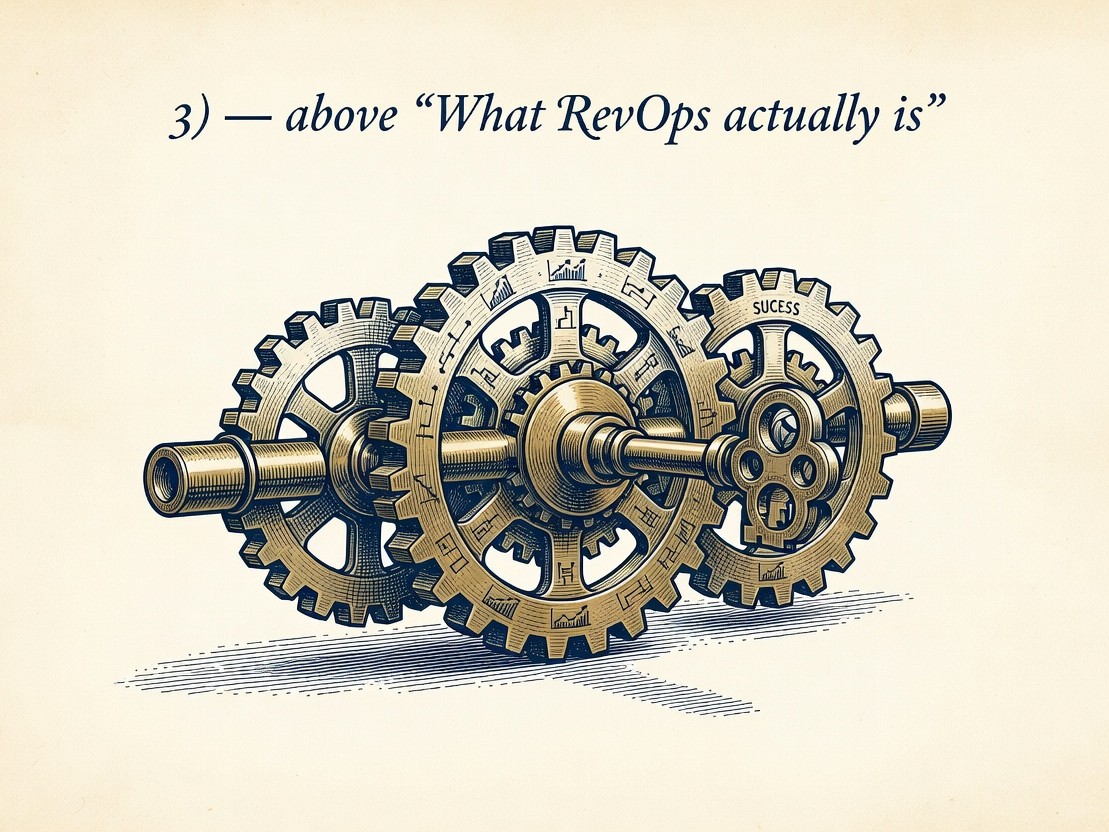
What RevOps Actually Is: One Owner Over the Whole Machine
RevOps is one accountable function that owns the systems, data, and process across marketing, sales, and customer success, so the entire revenue lifecycle runs as a single coordinated operation instead of three relay runners who keep dropping the baton. That is the whole definition, and the word that carries the weight is "accountable." Plenty of companies have a RevOps title on someone's badge. Far fewer have given that person actual authority over the tooling and the handoffs.
The model is winning because the siloed alternative is bleeding money. Misalignment between sales and marketing is estimated to cost businesses around $1 trillion a year, yet only 8% of companies report strong alignment between the two functions, according to Sopro's 2026 alignment statistics. The gap between perception and reality is almost funny: Forrester found that 82% of C-level executives believe their teams are already in sync, while 65% of the practitioners doing the actual work say they are not. Revenue operations exists to close that gap with structure rather than optimism.
Here is the practical test. In a company without RevOps, ask three people what counts as a sales-qualified lead and you get three answers, two arguments, and a meeting. In a company with real revenue operations, there is one definition, it lives in one system, and the handoff from marketing to sales to success is instrumented so you can see exactly where it breaks. The function is not glamorous. It is plumbing, accountability, and a shared source of truth. That is also exactly why it works.
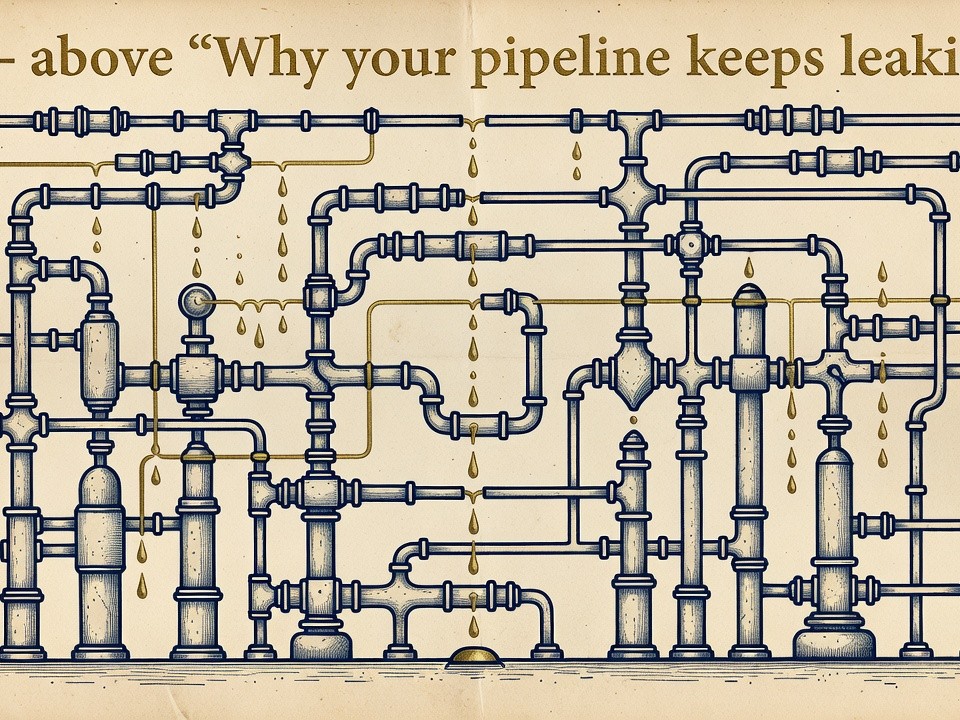
Why Your Pipeline Keeps Leaking: Disconnected Systems and Bad Data
Your pipeline leaks for two boring, fixable reasons: your systems do not talk to each other, and the data inside them is quietly rotting. Neither is a sales-talent problem, which is why hiring closers never fixes it. The leak is structural, and structure is what RevOps owns.
Start with the disconnected systems. Most revenue leakage hides in the gaps between systems, in manual handoffs, and in processes that lack oversight, per Maxio. When marketing automation, the CRM, and the billing platform each hold a slightly different version of the truth, work falls into the gaps between them. A lead gets routed to a rep who already left. A renewal nobody owns lapses in silence. A discount that was supposed to expire keeps applying because no system told the other one the deal closed.
Then there is the data itself, which decays whether you look at it or not. B2B contact data degrades at about 2.1% per month, roughly 22.5% a year, and a striking 44% of companies report losing more than 10% of revenue specifically to CRM data decay, according to Landbase's data-decay research. Sales reps then burn an estimated 27% of their time wrestling with inaccurate records. Compound that across a year and you are paying skilled people to maintain a database that is lying to them. Revenue operations treats this as a standing function: one owner, clean handoffs between connected systems, and data hygiene as routine maintenance rather than an annual fire drill.
What RevOps Does Day to Day, and How to Start
What RevOps does is run the revenue engine as one system: it owns the tool stack, defines the funnel stages everyone agrees on, instruments the handoffs, guards the data, and reports a single set of numbers leadership can actually trust. It is the difference between a dashboard that three teams argue about and a dashboard nobody disputes because there is only one.
The business case for getting this right is not subtle. RevOps adopters grow nearly 3x faster than non-adopters, and 97% of organizations report measurable ROI from the function, per Qwilr's 2025 statistics. The market agrees with its wallet: the revenue operations technology space is projected to grow at a 16.6% compound annual rate through 2033, according to Grand View Research. That is what happens when a discipline stops being a nice-to-have and starts being the thing that decides whether your forecast is real.
You do not need a reorg to begin. Start by naming one accountable owner for the full funnel, even part-time, so the handoffs finally answer to a single person. Then pick the one system that should be your source of truth and make every other tool defer to it, which kills the "whose number is right" argument at the root. Then make data hygiene a recurring job rather than a heroic quarterly cleanup. Do those three things and the leak narrows fast, because most of it was never a mystery. It was just nobody's job. If you suspect your revenue is quietly draining through the seams between your systems, book a Systems Diagnostic Call and we will find the biggest leak first.

Frequently Asked Questions
What Does RevOps Do?
RevOps unifies the people, process, data, and tools across marketing, sales, and customer success under one accountable owner. Day to day that means owning the tool stack, defining shared funnel stages, instrumenting the handoffs between teams, keeping the data clean, and reporting a single set of revenue numbers that leadership can trust instead of three competing versions.
What Is the Difference Between RevOps and Sales Operations?
Sales operations supports one team: it makes the sales org more efficient with territory planning, quota setting, and CRM administration. Revenue operations sits one level up and owns the entire revenue lifecycle end to end, from the first marketing touch through the renewal. Sales ops optimizes a department. RevOps optimizes the whole machine and the seams between its parts.
How Does RevOps Stop Pipeline Leakage?
It removes the two structural causes of leakage. First, it connects the disconnected systems so a lead, a deal, or a renewal cannot fall into the gap between your CRM, your marketing platform, and your billing tool. Second, it treats data decay as a standing job, so reps stop chasing contacts who left months ago. Connected systems plus clean data is most of the fix.
Do Small Companies Need RevOps?
Smaller companies need the discipline more than the title. You may not hire a dedicated team, but you absolutely need one accountable owner, a single source of truth, and clean handoffs. Adoption among small businesses still trails larger firms, but it is accelerating fast, because the cost of leakage does not wait for you to reach enterprise scale.
How Do I Know if My Company Has a Revenue Leakage Problem?
Look for the tells: your teams argue about whose number is right, leads go cold without a clear owner, renewals occasionally lapse by surprise, and your CRM is full of contacts at companies they no longer work for. If two or more of those are true, you are likely losing the typical 7% to 10% of revenue to leakage, and a RevOps function is the structural fix.