

The Frameworks for Building Agents in 2026, Compared
- The real agent frameworks comparison in 2026 is not tool versus tool, it is three build modes: orchestration frameworks, managed platforms, and roll-your-own.
- This is not a fringe decision anymore. Gartner expects 40% of enterprise apps to ship task-specific agents by the end of 2026, up from under 5% a year earlier.
- Frameworks earn their keep the moment you need retries, tool routing, human-in-the-loop, and observability, which is sooner than most founders expect.
- Match the choice to your team's control needs, ops capacity, and appetite for vendor lock-in versus maintenance lock-in, not to a feature checklist.
Every few weeks someone sends me a ranked list of "the best AI agent frameworks," and every few weeks I have the same reaction: the ranking is answering the wrong question. A useful agent frameworks comparison does not start with LangGraph versus CrewAI. It starts with how much of the plumbing you want to own. I have been building with this stuff since 2016, back when "agent" mostly meant a chatbot with a short temper, and the pattern has held: teams do not fail because they picked the wrong library. They fail because they never decided which of three roads they were on.

Three Ways to Build an Agent
There are three ways to build an agent, and everything else is a variation on them: use an orchestration framework, buy a managed platform, or roll your own on top of raw model APIs. An orchestration framework (LangGraph, CrewAI, AutoGen, LlamaIndex workflows) gives you the control loop, state, tool routing, and retries as code you own and run. A managed platform (the OpenAI Agents SDK runtime, Dify, and similar hosted stacks) hands you deployment, observability, and guardrails behind a console, in exchange for living inside someone's opinions. Roll-your-own means you wire the model calls, memory, and error handling yourself, from scratch.
This is not a demo-stage question anymore. Gartner expects 40% of enterprise apps to ship task-specific agents by the end of 2026, up from under 5% a year earlier. And in LangChain's State of AI Agents report, which surveyed more than 1,300 professionals, 57% of teams said they already run agents in production and another 30% are actively building toward it. So most of your peers are past the proof of concept and into the part where reliability and cost actually bite. That is the lens for the rest of this piece.

Orchestration Frameworks Compared
Orchestration frameworks win when you care more about precise control than convenience, and they are where most serious agent work lives. When an agent has to survive weird production traffic, you want explicit graphs, checkpointing, and named failure modes, not a magic loop you cannot inspect. That is LangGraph's whole pitch: low-level control over state, retries, and failure handling. The flip side is real work, because you own the runtime, the upgrades, and the on-call pager.
The frameworks differ mostly in taste. CrewAI leans into role-based multi-agent setups with little boilerplate, AutoGen into conversational and asynchronous agents, LangGraph into low-level graph control. In any honest agent frameworks comparison, those are ergonomics choices sitting on top of the same core capability, and smaller teams are adopting them fast: in the same LangChain survey, 50% of organizations under 100 people already run agents in production. The framework is not the moat. The judgment about what your agent should and should not do is.

Managed Platforms and Their Ceilings
Managed platforms are the right call when you want hosted deployment, built-in observability, and low operational overhead, which is why smaller teams reach for them first. If you have five engineers and no platform team, paying someone else to run the runtime is not laziness, it is arithmetic. You get to production faster and you spend your scarce attention on the agent's behavior instead of its plumbing.
The ceiling shows up later. Managed platforms make the easy 80% effortless and the hard 20% awkward, because the hard 20% is usually the custom control flow, the odd tool, or the compliance boundary the platform did not anticipate. There is also a strategic cost: if your orchestration, tools, and memory all live inside one vendor's worldview, you inherit their pace and their limits. I treat MCP and similar standards as an integration layer, not as an architecture, precisely so that boundary stays movable. If that independence matters to you, my earlier piece on owning your stack with open-weight models walks through where it is worth paying for.
When Rolling Your Own Makes Sense
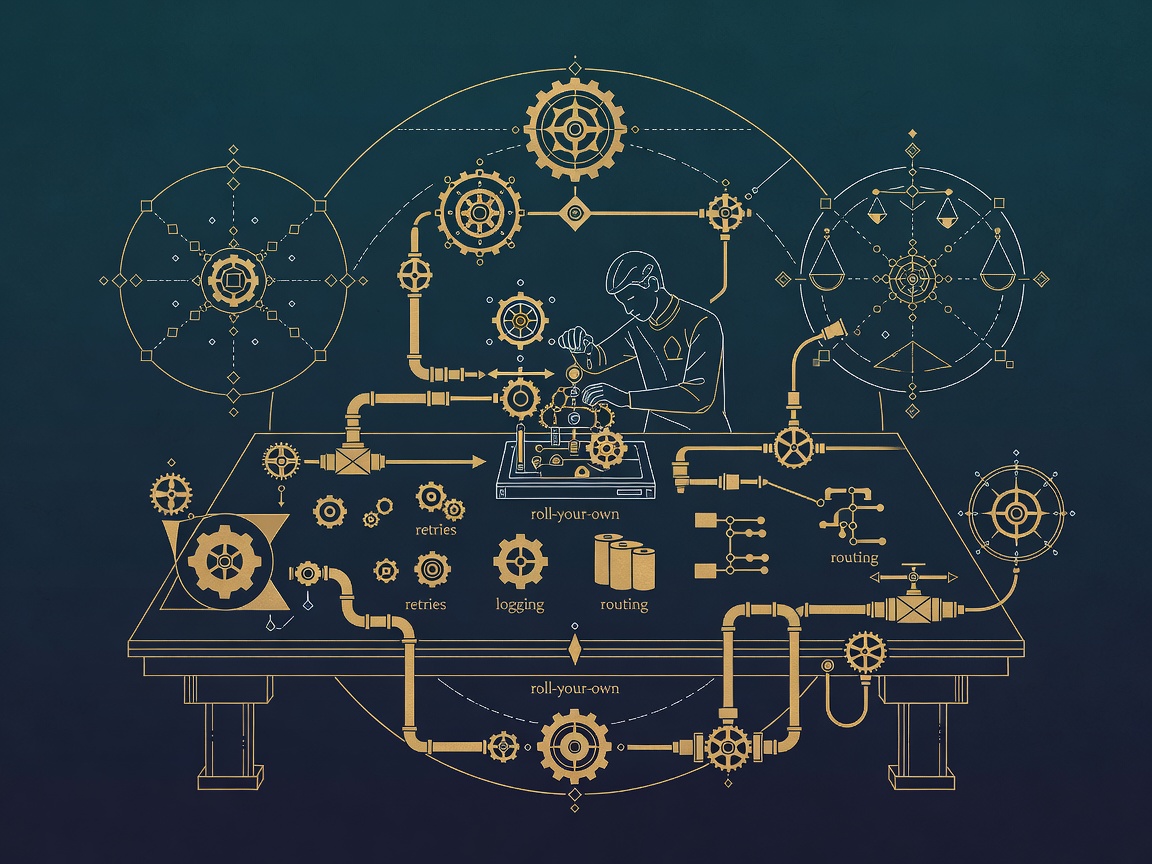
Rolling your own makes sense in a narrow band: you have a platform team, an unusual control or compliance requirement, and enough scale that a framework's abstractions get in your way. For almost everyone else, it is a trap dressed as freedom. The pattern I see over and over is that a team builds a "tiny agent runtime" on raw model calls and then slowly rebuilds half of LangGraph anyway, the logging, retries, tool routing, human-in-the-loop, and coordination. Under about 50 engineers with no platform team, that usually just trades vendor lock-in for maintenance lock-in.
The reliability data explains why that rebuilt plumbing matters so much. Analyses of production agents point to roughly a 37% gap between how systems score in the lab and how they behave in the wild, and most production failures trace to data quality, context gaps, and governance rather than the model itself, according to work on the agent reliability gap. It also shows up as pilots that quietly stall: in LangChain's survey, 32% of teams that start an agent pilot never move it to production. If you build the runtime yourself, you are volunteering to own every one of those failure modes, and to keep owning them. This is the same reason so many pilots stall at integration rather than intelligence, which I unpacked in why most agentic pilots die in the handoff.

Matching the Choice to Your Team
The right choice falls out of three questions about your team, not out of any leaderboard. First, how much control do you actually need? Compliance boundaries, custom tools, and strange control flow push you toward orchestration frameworks or roll-your-own. Second, how much operational capacity do you have? No platform team points hard at a managed platform, at least until you outgrow it. Third, how much lock-in can you stomach, vendor or maintenance? There is no zero-lock-in option, only which flavor you would rather manage.
Turning the Agent Frameworks Comparison Into a Decision
A reasonable default for the teams I work with (independent consultants, growth-stage companies, education, and government) is to start on a managed platform or a mainstream orchestration framework, keep your tools and memory portable behind an integration layer, and only consider rolling your own once a framework is demonstrably fighting you. That keeps the reliability scaffolding someone else's problem while you learn what your agents actually need. If you are weighing that first fork more broadly, my off-the-shelf versus custom agents piece treats it as a portfolio decision rather than a one-time bet. The framework matters far less than being honest about which of the three roads you are on.

Frequently Asked Questions
What Is an AI Agent Framework?
An AI agent framework is the software layer that handles an agent's plumbing: tool and function calling, state and memory, retries, routing, and multi-step control. It lets you write agent logic instead of rebuilding infrastructure every time.
What Is the Difference Between LangChain and LangGraph?
LangChain is a broad framework for building LLM applications. LangGraph is its graph-based runtime for stateful, cyclic, multi-step agent orchestration, where you want explicit control over transitions, checkpoints, and failure handling.
Should You Use an Agent Framework or Build Your Own?
Use a framework once you need retries, tool routing, human-in-the-loop, and observability, which is most production cases. Rolling your own only pays off with a platform team and unusual control or compliance needs, because custom runtimes tend to re-implement framework features over time.
When Should You Use a Managed Agent Platform Instead of Open Source?
Choose a managed platform when you want hosted deployment, built-in observability, and low operational overhead, which is common for small teams. Choose open source when you need self-hosting, maximum control, or lower vendor dependency.
How Do You Read an Agent Frameworks Comparison for Production?
Weigh workflow complexity, multi-agent needs, state and memory handling, deployment model, security and compliance, and how much platform opinionation you can accept versus the flexibility you need. Those factors decide the fit far more than any single framework's feature list.
References
- Gartner: 40% of Enterprise Apps Will Feature Task-Specific AI Agents by 2026
- LangChain: State of AI Agents Report
- The Agent Reliability Gap: Benchmarks vs Production
- Automata Intel: Open-Weight Models Grew Up, Owning Your Stack
- Automata Intel: Why Most Agentic Pilots Die in the Handoff
- Automata Intel: Off-the-Shelf vs Custom Agents