
AI Implementation Consulting: What You're Actually Paying For
- AI implementation consulting is mostly organizational redesign and integration work, not model selection. The model is the cheap part. Wiring it into how your business actually runs is the expensive, valuable part.
- The failure data is brutal and consistent: 42% of companies scrapped at least one AI initiative in 2025, up from 17% a year earlier, per S&P Global Market Intelligence, and MIT found 95% of enterprise GenAI pilots delivered no measurable P&L impact in its State of AI in Business 2025.
- Those projects rarely die from a weak model. They die because nobody redesigned the workflow around it. MIT's own finding: integration, not technology, is the gap.
- A good implementation partner sells you a working function. A bad one sells you a model and a slide deck, then leaves before the integration starts.
- What you are actually paying for: someone who scopes the real problem, redesigns the process, does the unglamorous plumbing into your existing systems, and stays until the thing produces a number.
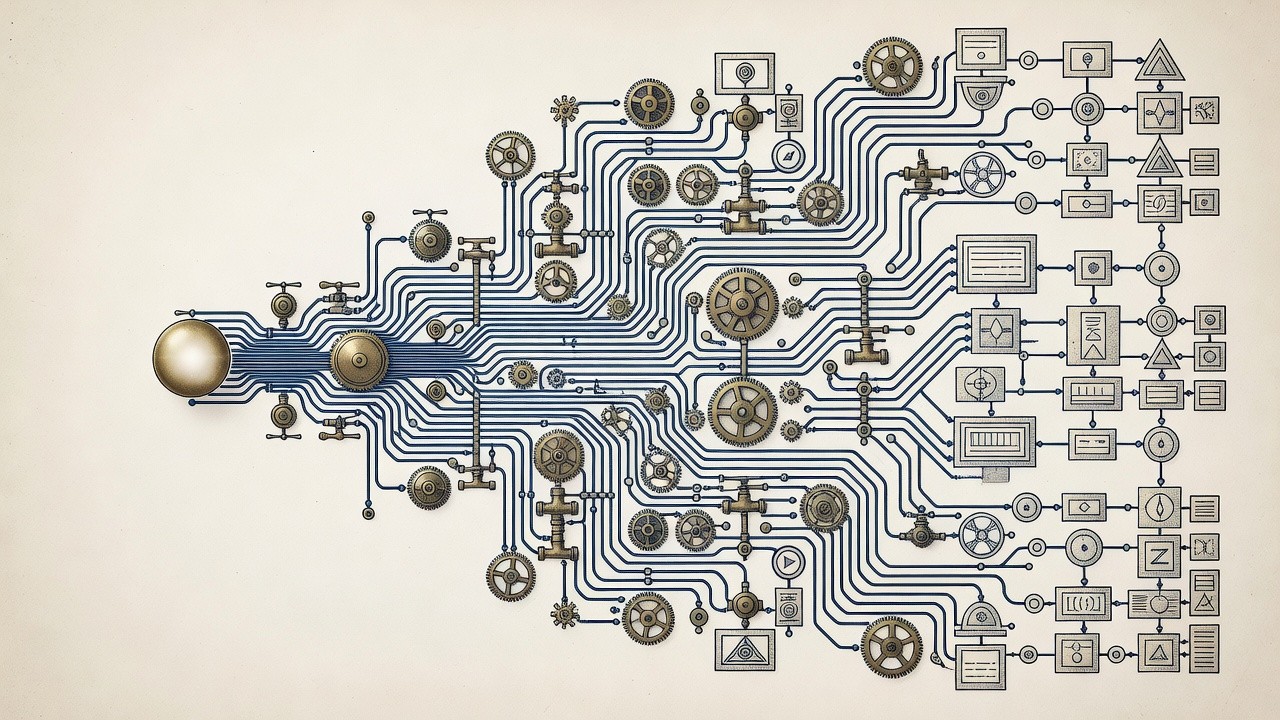
Most people shopping for AI implementation consulting think they are buying a model, or access to one, or the cleverness to pick the right one. They are not. The model is a commodity you can rent by the token. What you are paying a good implementation partner for is the part no demo shows you: redesigning how the work flows, then connecting the model to the messy reality of your existing systems, data, and people. That is where roughly four-fifths of the value lives, and it is the part everyone underestimates.
I run a firm that does this work, so I will admit my bias up front, with the usual self-deprecation: I have personally underestimated the integration half of a project more times than I would like to put in writing. The lesson keeps repeating. The model walks in the door working. The organization it walks into was built for humans, has six systems that do not talk to each other, and a process that lives mostly in one person's head. Bridging that gap is the job.
This article is about what a good implementation partner actually does versus what the market sells, why the integration and redesign work dwarfs the model, and how to tell the difference before you sign.

What You're Actually Paying for (It Isn't the Model)
You are paying for the org redesign and the integration, not the model. That is the whole thesis, and the data makes it uncomfortably clear. MIT's State of AI in Business 2025 found that 95% of enterprise GenAI pilots produced no measurable P&L impact, and the root cause was not model quality. It was a "learning gap," the inability of organizations to fold the model into their actual workflows, structures, and data. The model was fine. The function around it never got built.
Think about what that means for where the money goes. Picking a model is a few weeks of evaluation, and frankly the frontier options are close enough now that the choice rarely decides the outcome. The expensive work is everything after: mapping the process that the model is supposed to improve, deciding what the model owns versus what a human owns, connecting it to the CRM and the ticketing system and the spreadsheet that secretly runs the department, cleaning the data so the model has something true to work with, and instrumenting the whole thing so you can prove it worked. None of that is AI. All of it is the job.
There is a tell I look for in any implementation proposal. If the pitch is mostly about which model and how clever the prompting is, and almost nothing about your existing systems, your data, and who owns the new workflow, you are buying a demo. A demo is the first 20% of the work dressed up to look like the finish line. The 80% that follows is the unglamorous middle: the plumbing, the redesign, the change management, the boring instrumentation. That is the part you are actually paying a partner to carry, and it is the part that determines whether you join the 42% who abandoned an initiative in 2025 or the small group that got a result.

Why Integration Is the Hard Part (and the Data Agrees)
Integration is the hard part because your business was not designed to be integrated with anything, least of all a model that wants clean data and a clear job. The surveys are unanimous on this. The World Quality Report 2025 puts integration complexity at 64% among the top barriers to scaling AI, sitting right alongside data privacy and skills gaps. Nearly 60% of AI leaders name integrating with legacy systems as a primary obstacle to deploying agentic AI. And 76% still wrestle with fundamental data problems: legacy infrastructure, siloed datasets, the disconnected sources that quietly sabotage every clever model you put in front of them.
This is the work that does not photograph well. Legacy systems lack modern APIs, so somebody has to build the connective tissue. Data lives in three formats across five tools, so somebody has to reconcile it before the model sees it. The process the model is meant to run has undocumented exceptions that only the veteran in accounts payable knows about, so somebody has to surface them. A good implementation partner spends most of the engagement here, in the plumbing, because this is precisely where the projects that fail went wrong. They built a smart pilot that lived as a standalone toy, never wired into the systems and data that would have made it real.
Here is the buy-versus-build wrinkle that makes integration even more central. MIT's research found that externally built tools succeeded roughly twice as often as internal builds. Not because outside vendors have better models, everyone has the same models, but because doing integration well is a specialized, repeatable discipline that most internal teams are attempting for the first time. When you buy implementation consulting, you are renting that discipline: the patterns, the scar tissue, the knowledge of which integrations look easy and turn out to be a six-week swamp. The model is free. The map through the swamp is what you pay for.

How to Tell a Real Implementation Partner From a Model Reseller
A real partner can tell you, before you sign, what business number will move and how the work will reach your existing systems. A model reseller talks about capabilities, demos, and the future. That is the fastest way to tell them apart, and given that enterprises are projected to spend $644 billion on AI in 2025 while most see no material earnings impact, the distinction is worth real diligence.
Ask three questions and listen for the shape of the answers. First: what specific process are we changing, and what does it look like today? A real partner will want to map your current workflow in uncomfortable detail before proposing anything, because they know the redesign is the product. A reseller will steer back to the model. Second: how does this connect to the systems we already run? A real partner will ask about your CRM, your data, your existing tools, and your worst integration nightmare, because the plumbing is where they earn their fee. A reseller will wave at "seamless integration" and move on. Third: what number will move, and how will we know? A real partner will name a metric and insist on instrumenting it. A reseller will sell you adoption, which is the metric that lets everyone feel busy while proving nothing.
The market is full of resellers right now because the market is enormous. The AI consulting market is growing past $11 billion in 2025 toward roughly $91 billion by 2035, and a lot of that money is chasing the easy, visible part: the model, the demo, the proof of concept that wins the meeting and then quietly dies. The partner worth hiring is the one who treats the proof of concept as the start, not the end, and who is still in the room during the unglamorous months when the integration and the redesign actually happen. That is what you are paying for. Everything else is a very expensive demo.

Frequently Asked Questions
What Does AI Implementation Consulting Actually Include?
Good AI implementation consulting includes scoping the real business problem, redesigning the workflow around the model, integrating it with your existing systems and data, handling the change management so people actually use it, and instrumenting a metric so you can prove it worked. Model selection is a small early step, not the bulk of the engagement. If a proposal is mostly about which model and prompting, you are buying a demo, not an implementation.
Why Do So Many AI Projects Fail?
Most fail on integration and organizational redesign, not model quality. MIT found 95% of enterprise GenAI pilots delivered no measurable P&L impact, with the root cause being a "learning gap": the inability to fold the model into real workflows and data. The model usually works fine in the demo. The function around it was never built, so it never produced a result anyone could measure.
Should I Buy or Build My AI Implementation?
For most teams, buying or partnering beats building the first time. MIT's research found externally built tools succeeded roughly twice as often as internal builds, not because of better models but because integration is a specialized, repeatable discipline. Build internally once you have done it a few times with a partner and developed your own integration patterns and scar tissue.
How Much of an AI Implementation Budget Goes to the Model Versus Integration?
Far more goes to integration and redesign than to the model. Model selection is a few weeks of evaluation, and frontier options are close enough that the choice rarely decides the outcome. The bulk of the work and the budget is the workflow redesign, the connections to your existing systems, the data cleanup, and the instrumentation. Roughly four-fifths of the value lives in the part no demo shows you.
How Do I Evaluate an AI Implementation Consulting Partner?
Ask three questions before signing. What specific process are we changing, and what does it look like today? How does this connect to the systems we already run? What business number will move, and how will we measure it? A real partner maps your workflow in detail, interrogates your existing systems and data, and names a metric. A model reseller redirects to capabilities and demos.
References
- MIT NANDA, State of AI in Business 2025 (95% of GenAI pilots, the "learning gap," external vs internal builds)
- S&P Global Market Intelligence via Fluid Labs: 42% of enterprises abandoned an AI initiative in 2025
- World Quality Report 2025 via Tredence: integration complexity (64%) and legacy-system barriers to AI scaling
- Fullview: 200+ AI statistics 2025 ($644 billion enterprise AI spend, earnings-impact gap)
- Future Market Insights: AI Consulting Services Market size and forecast 2025 to 2035