
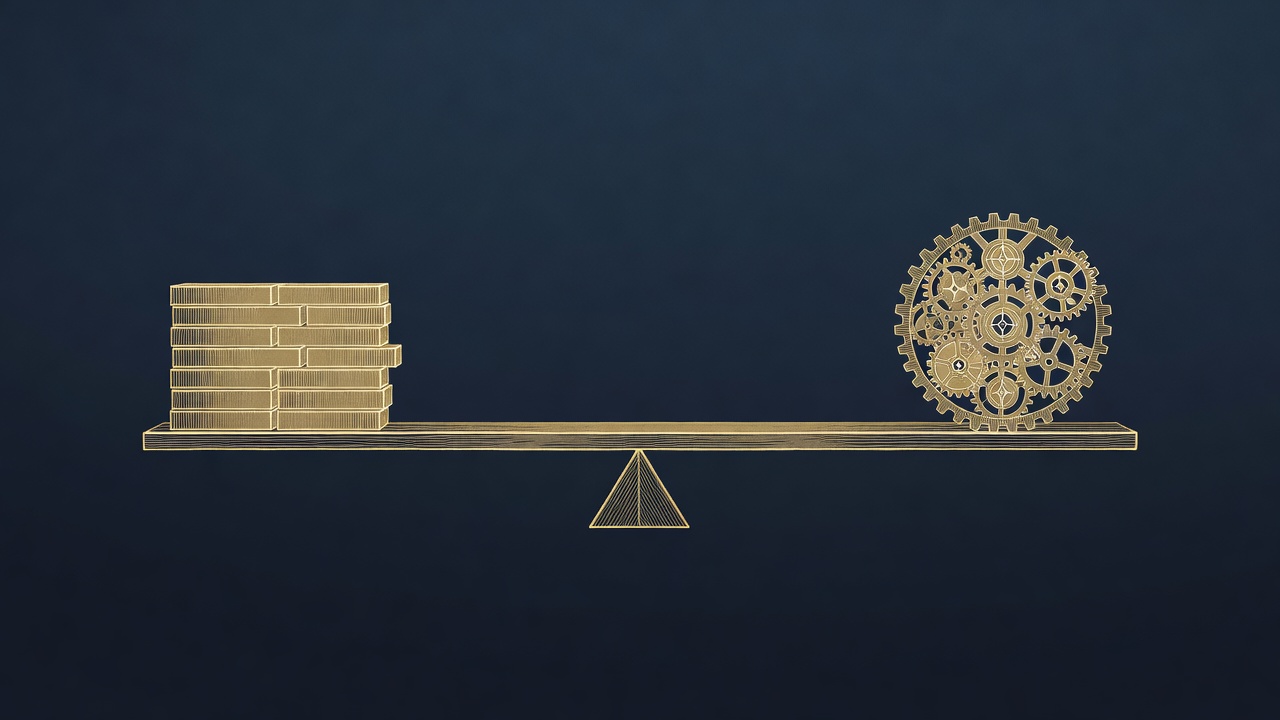
Off-the-Shelf vs Custom Agents: A Decision You Don't Have to Make Once
- Off-the-shelf vs custom AI is not a one-time fork in the road. The smartest 2026 buyers treat it as a portfolio decision they revisit, not a wedding they commit to.
- Buy the commodity. For roughly 90% of enterprise use cases, an off-the-shelf agent platform is the practical choice because it collapses time-to-value from about 18 months to weeks.
- Build the moat. Reserve custom agents for proprietary data, regulated or sovereign workflows, and the handful of processes that actually differentiate you.
- Most companies are already living this way. 47% of enterprises now blend off-the-shelf and custom agents, so the real question is which workflow gets which treatment.
- The mix is not permanent. What you buy this year you may build next year, and what you built may get retired when the market catches up. Plan to rebalance.
For the last few years I have watched smart people turn a perfectly ordinary purchasing decision into a religious war. Off-the-shelf vs custom AI gets framed as a single, fateful choice: pick the wrong side and you are either a sucker who rents forever or a cowboy who builds a money pit. I have been working with this technology since 2016, long enough to tell you the framing is wrong. The decision is not a fork. It is a portfolio, and the people getting real value out of agents in 2026 manage it like one.

The Fork That Isn't a Fork
The build-versus-buy fork is a false binary, and treating it as one is the actual mistake. You do not choose off-the-shelf or custom for your whole company any more than you choose to either rent or own every tool in the building. You rent the floor buffer you use twice a year. You buy the machine your whole business runs on. The same logic applies to agents, workflow by workflow.
This is not a clever reframe I invented. It is what the market is already doing. According to Arcade's 2026 State of AI Agents report, 47% of enterprises already combine off-the-shelf agents with custom development. The pure-buy and pure-build camps are now the minority. Hybrid is the default, which means the interesting question moved. It is no longer "should we build or buy AI," it is "which of our workflows deserve which treatment, and how do we run both as one system."
If you have already read our cost-of-ownership take on build, buy, or both, this is the operational sequel. There we argued the decision lives in total cost of ownership. Here I want to argue something adjacent: that the decision is plural, ongoing, and best made at the level of the individual workflow rather than the whole org.
What Off-the-Shelf Is Great At
Off-the-shelf AI wins on speed, maintenance, and the boring parts you should not be reinventing. When a workflow is a commodity, meaning lots of companies do it roughly the same way, somebody has already built a good agent for it and is amortizing the cost across thousands of customers. You will not beat that economically by hand-rolling your own.
The numbers are lopsided for a reason. Aisera estimates that for about 90% of enterprise use cases, buying an agent platform is the most practical choice, cutting time-to-value from roughly 18 months for an in-house build down to a matter of weeks and lowering total cost of ownership by offloading the infrastructure babysitting. As Aisera puts it, buying "ships with built-in security and compliance," and building "should be reserved for agents that represent core IP or must run on highly sensitive, sovereign data." That is the right instinct.
There is also a quieter benefit: somebody else maintains it. Custom systems are not a one-time cost. White Label IQ, citing RAND research, notes that ongoing maintenance for custom AI agents typically runs 15 to 25% of the original build cost per year, and that over 80% of AI projects fail, roughly twice the rate of non-AI technology projects. Every workflow you buy instead of build is a maintenance bill and a failure risk you handed to a vendor whose entire business is keeping it running. Use off-the-shelf for scheduling, transcription, support triage, document summarization, the standard sales-development motions, and the dozen other things that are not what makes your company yours.
The one honest caveat is lock-in, and it is real. Renting convenience can quietly become renting dependence. We wrote a whole piece on why vendor lock-in is just outsourcing with better branding, and the short version is: buy freely, but keep your data portable and your exits cheap.

What Only Custom Can Do
Custom AI earns its keep when a workflow touches proprietary data, a regulated boundary, or the thing that actually differentiates you. Off-the-shelf is built for the average customer. If your advantage is that you are not the average customer, a generic tool will sand that advantage right off.
The scoping test I like comes from White Label IQ: ask whether the client "needs something that doesn't exist, or needs help finding and configuring what already does." Most of the time it is the latter, and you should buy. But custom is warranted when you hit one of four walls: proprietary data pipelines that no vendor models, domain-specific reasoning beyond what general models do well, strict regulatory or sovereignty constraints on where data can live, or a genuinely unique workflow that is part of your moat.
Notice that "we want it to feel like ours" is not on that list. Cosmetic customization is the most expensive way to lose money in AI. The bar for building is that the workflow is both high-value and unavailable in a form you can trust. When you do build, build for adoption, not for the demo. The custom agents that pay off are the ones people actually use, which is a design problem as much as an engineering one, and the subject of our guide to designing a custom agent your team will actually use. A brilliant agent nobody opens is just an expensive maintenance contract.

Running It as a Portfolio
The portfolio approach means sorting every candidate workflow onto a simple grid and letting the grid pick the treatment. Two axes do most of the work: how much the workflow differentiates you, and how well an off-the-shelf option already covers it. Commodity workflow with good coverage, buy it. Differentiating workflow with no good coverage, build it. The interesting cases live in between, and that is where most of the judgment goes.
A practical way to manage the in-between is to buy first and build later, deliberately. Start a workflow on an off-the-shelf tool to learn what you actually need. You will discover your real requirements by using something, not by writing a spec in a vacuum. If the tool stays good enough, you never have to build. If you outgrow it, you now have a precise, battle-tested spec for the custom version and a clear ROI case for it. The payback math supports moving fast: across functions, the median payback period for AI agent deployments is 5.1 months, with sales-development agents paying back in about 3.4 months, according to 2026 surveys aggregated by Digital Applied. When payback is measured in months, the cost of starting with the wrong tool is low and the cost of analysis paralysis is high.
The integration layer is what turns a pile of bought and built agents into one system. This is the part nobody budgets for and everybody pays for anyway. Off-the-shelf agents that cannot talk to each other, or to your custom ones, are just a more expensive version of the silos you were trying to escape. Integration is where the value of a portfolio actually lives, which is why I keep saying it is the work that matters more than the build-or-buy label on any single piece.
Revisiting the Mix as You Grow
Your buy-build mix has a shelf life, so put a date on the calendar to rebalance it. The decision you make this year is correct for this year's market, this year's data, and this year's headcount. All three move. The off-the-shelf market is improving so fast that something you built in 2024 because nothing existed may have three good vendors today. The reverse happens too: a workflow you happily rented may have become your differentiator, and now it deserves to be brought in-house.
Treat the portfolio like an actual portfolio. Review it on a cadence, quarterly is plenty for most companies, and ask three questions of each piece. Has an off-the-shelf option caught up to something we built, so we can retire our maintenance burden? Has something we bought become core enough that we now want control? Is anything we run, bought or built, simply not earning its keep? The answer to most of these will be "no change," and that is fine. The point is to make the no-change a decision rather than an accident.
The cost of getting this wrong is not catastrophic in any single quarter. It is the slow tax of running the wrong mix: paying to maintain custom code the market has commoditized, or paying subscription fees on a workflow that quietly became your edge. Rebalancing is cheap. Drifting is what gets expensive.

Frequently Asked Questions
What Is the Difference Between Off-the-Shelf and Custom AI Solutions?
Off-the-shelf AI tools are pre-built SaaS products with fixed features, fast setup, and subscription pricing. Custom AI is engineered around your own workflows, data, and compliance needs to create proprietary capability and durable differentiation. The first optimizes for speed and cost, the second for control and fit.
Is It Cheaper to Build or Buy AI for My Business?
Buying is almost always cheaper upfront and faster to deploy. Building custom AI carries heavy initial investment plus 15 to 25% annual maintenance, but it can lower long-run cost where it replaces several subscriptions or deeply optimizes a complex core process. Compare total cost of ownership over 12 to 24 months, not just the sticker price.
When Should a Company Choose Custom AI Instead of Off-the-Shelf Tools?
Choose custom when you need proprietary functionality, work with highly regulated or sovereign data, run complex cross-functional workflows, or want a competitive advantage generic tools cannot provide. If an existing tool can be configured to do the job, buy it instead.
Can I Use Both Off-the-Shelf and Custom AI Together?
Yes, and most scaling companies do. The hybrid portfolio buys off-the-shelf for standardized, low-variance tasks and builds custom agents on proprietary data for high-value workflows. It balances speed, cost, and differentiation while limiting vendor lock-in, which is why 47% of enterprises already work this way.
How Do I Compare the ROI of Building vs Buying AI Agents?
Model total cost of ownership over 12 to 24 months, including licenses, integration, maintenance, lock-in, and workarounds, then weigh it against automation coverage, cycle-time gains, and payback period. Off-the-shelf usually wins on speed of return; custom wins on long-term strategic value where the workflow is genuinely yours.
References
- Arcade - State of AI Agents 2026
- Aisera - Build vs Buy AI Agents (2026)
- White Label IQ - Custom AI Agents vs Off-the-Shelf Tools
- Digital Applied - AI Agent Adoption 2026
- Build, Buy, or Both: A Cost-of-Ownership Way to Decide
- Designing a Custom AI Agent Your Team Will Actually Use
- Vendor Lock-In Is Just Outsourcing With Better Branding